How to plan your homeschool year
The plans that last are loose for the year and specific for the week. Parents who plan every lesson in August often say the same thing by October: one long math lesson and half the week gets erased. So plan the year in broad strokes, plan each week in detail, and write down what actually happened.
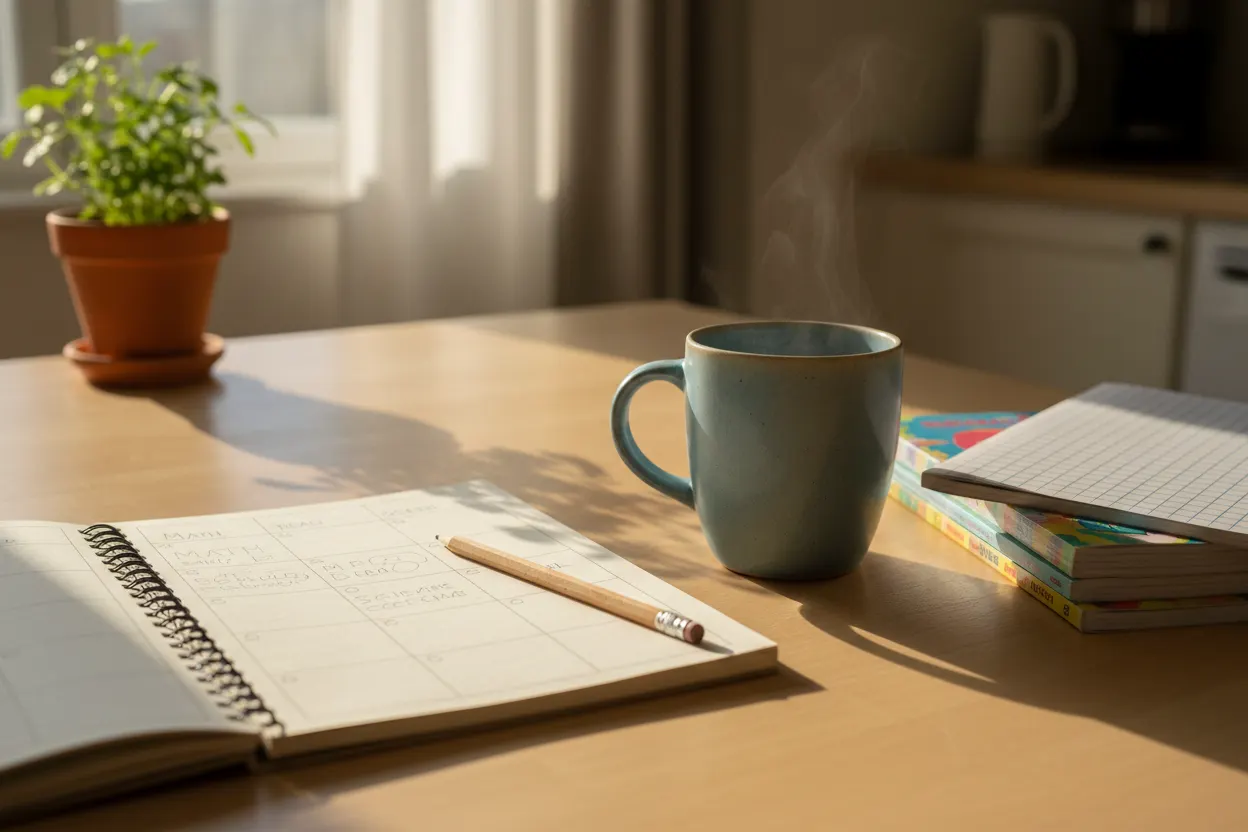
Here's how, in five steps.
1. What does your state require?
It depends on the state: some set a number of days or hours, and some set nothing.
Start here, because it sets your minimums. Some states set a number of days or hours, and some set nothing:
- Pennsylvania: 180 days, or 900 hours (K–6) / 990 hours (7–12).
- New York: the equivalent of 180 days; 900 hours for grades 1–6, 990 for 7–12.
- Texas and Florida: no required days or hours.
See Texas and Florida, all states side by side, or check your state's education department.
See also: how many hours a day should you homeschool and, for the day-to-day order, how to make a homeschool schedule
2. How many weeks is a homeschool year?
Choose a start date and how many weeks you'll school. 36 weeks of 5 days makes 180 days, a common target even where it isn't required. Then mark the breaks you already know about: holidays, a family trip, a week off each term. Many families plan a few spare weeks for sick days and slow patches.
Example year (example only): start August 18, 36 school weeks, a week off at Thanksgiving, two at Christmas, one in spring. Finish in late May.
3. How do you set a pace for each subject?
For each subject, write down what you'll get through this year and divide by your weeks. Not every lesson, just the pace:
- Math: 150 lessons over 36 weeks ≈ 4 a week
- Reading: 12 books ≈ one every 3 weeks
- Science: 30 chapters ≈ one a week, with spare weeks
That's your year plan. It fits on one page, and it tells you each week whether you're on track.
4. How detailed should your weekly plan be?
Each weekend (or Monday morning), look at the pace for each subject and write the week: which lessons on which days. Keep it light. Leave one lighter day for catching up, outings or a lesson that ran long.
A weekly plan is easy to change. If Tuesday falls apart, move it to Friday, not to "next August".
5. Should you log what you actually did?
Yes. A two-minute note each day is the record you'll need later.
At the end of each day, take two minutes: what you did, what you read, how long you spent. Some parents only do this and skip the detailed plan ("reverse planning"). Either way, this log is what you'll need later:
- It shows whether you're keeping pace.
- It's your attendance and hours record.
- In states that want a portfolio log (Florida, Pennsylvania), it is the log.
- In high school, it becomes the courses and credits on the transcript.
More in what homeschool records to keep.
Should you plan on paper, in a spreadsheet or in an app?
Any of them works. What breaks is using three at once: the year in a notebook, weeks in a spreadsheet, the log on your phone. Pick one place.
- Paper: easy to start; hard to move unfinished lessons around, and you add up days and hours by hand.
- Spreadsheet: flexible; you build and fix it yourself.
A quick checklist
- State minimums written down (days, hours, subjects)
- Start date, number of weeks, breaks marked
- A pace for each subject
- This week's plan
- A two-minute daily log